
Direct answer
Diwali and Lakshmi–Ganesha Puja fall around 8 November 2026 in India. In the New Delhi reference calendar, Naraka Chaturdashi and Lakshmi–Ganesha Puja share Sunday 8 November 2026. That is a civil date, not a muhurta. The worship window belongs to a city: use a local panchang, or the temple or family almanac you already trust. This page is a planning checklist for the week before and for the days from Dhanteras through Bhai Dooj, including apartments and other time zones. It does not repeat a puja sequence.
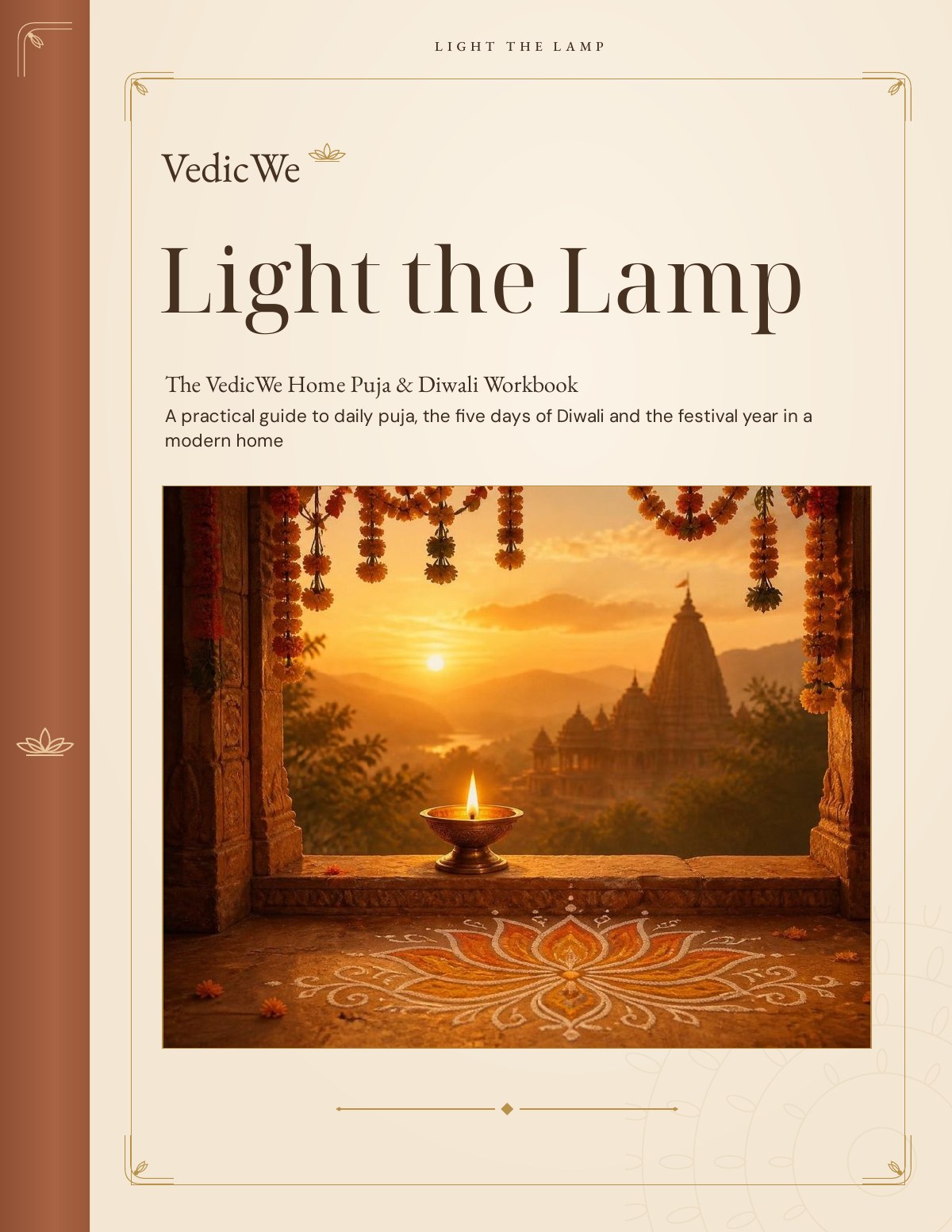
For home puja, Light the Lamp (Dhanteras to Bhai Dooj, day by day) is a 144-page PDF workbook ($5.99).
What this page covers
The step-by-step home sequence for Lakshmi Puja lives in the Lakshmi Puja at home guide. Wider regional frames are in the Diwali puja vidhi guide. A samagri prompt, with every item optional unless your household uses it, is in the Diwali puja items list. The surrounding season is in the November 2026 to January 2027 festival calendar.
Use this page to decide which days you are observing, what to prepare in the week before, how to handle flame in a flat, and how to read a date outside India. If your family or temple has already given you a rite, follow that. A published checklist is a reference. It is not a rule for every region, language or sampradaya.
New Delhi reference dates for 2026
These civil dates are the New Delhi reference already used for the VedicWe Light the Lamp date table, drawn from Drik Panchang. They are not clock times, and they are not a claim that every Indian city, or every tradition, shares the same civil date.
- Dhanteras: Friday 6 November 2026
- Naraka Chaturdashi: Sunday 8 November 2026
- Lakshmi–Ganesha Puja: Sunday 8 November 2026
- Govardhan Puja: Tuesday 10 November 2026
- Bhai Dooj: Wednesday 11 November 2026
Saturday 7 November 2026 is not Naraka Chaturdashi in that five-day New Delhi table. Our November festival calendar lists Kali Chaudas on Saturday 7 November 2026, a regional observance in parts of western India. Some households call the day before Diwali Choti Diwali. That calendar also notes that some regional lists place Govardhan Puja on 9 November rather than 10 November. Confirm the civil date for your city before you travel, cook or take leave.
Drik Panchang also publishes muhurta windows on its festival pages. This article does not copy those minutes. A muhurta belongs to a place. A screenshot from another city is not your muhurta.
Time zones outside India
A tithi depends on the Moon and on local sunrise. The civil date of Lakshmi Puja in New Delhi can differ from the civil date in another country, and the worship window moves with the city. Adding or subtracting hours from Indian Standard Time does not produce a muhurta. Do not take an evening clock time published for India and shift it for London, Toronto, New York, Dubai, Singapore or Sydney.
Select your own city in a panchang, or ask the temple you attend which city and which regional calendar it follows. Diaspora temples sometimes follow a sampradaya calendar from India rather than local sunrise. Both choices exist. Neither is universal.
Joining family in India by video is a household choice. It is a way to be present with them. It is not the same thing as the muhurta for the city where you are.
If the local date and the Indian date fall on different civil days, keep the day your household or temple has chosen and name the calendar you are using. There is no single clock time for every family outside India.
The week before
Prepare only for the days your household observes. A shorter observance is still an observance.
- Name the days you will keep, and the city whose panchang you will trust.
- Read the local date for each of those days. Do not rely on a forwarded message that names no city.
- Clean the surface you will actually use. A separate room is unnecessary. Placement and clearance are covered in puja room setup.
- Decide before the week whether an open flame is allowed in the flat. If it is not, choose a battery or electric lamp now.
- Compare any shopping list with family custom. Reuse clean vessels and cloth. The items list is a prompt, not a purchase order.
- If you are choosing a new lamp or vessel, the buying checklist covers materials, size and care. A purchase is optional.
- Plan food that can be stored and shared. Note allergies. Do not cook quantities you cannot keep safely.
- Agree sibling visits or calls for Bhai Dooj, within means and across the time zones involved.
- Check building rules for balcony lamps, visitors and fireworks before you invite anyone.
- Leave debt out of the plan. A seller calling an object required does not make it required.
A short form for ordinary home worship, separate from the festival sequence, is described in how to do puja at home.
Day by day, at a high level
These notes say what the day is commonly for. They do not give the order of offerings, mantras or gestures. For a sequence, use your family, your temple, or the linked guide.
Dhanteras
In the New Delhi reference, Dhanteras falls on Friday 6 November 2026. Many households clean, light a lamp and mark the start of the festival period. Some include Lakshmi or Dhanvantari, or buy a household item. Buying metal is a custom in some families and not a requirement. Preparation is in the Dhanteras puja vidhi. Keep any entrance lamp where someone can see it.
The day before, where a region marks it
Kali Chaudas, and the name Choti Diwali, belong to particular regions. Do not assume a rite from western India applies in every home. If your family observes this day, use their custom and their local date. This checklist does not add a muhurta for it.
Naraka Chaturdashi and Deepavali in the south
In the New Delhi reference, Naraka Chaturdashi shares Sunday 8 November 2026 with Lakshmi–Ganesha Puja. In much of Tamil Nadu, Deepavali is observed on Naraka Chaturdashi, commonly in the early morning, with an oil bath, new clothes and lamps. Many households in Karnataka, Andhra Pradesh and Telangana also centre the festival on Naraka Chaturdashi. That morning emphasis is not the same observance as the Lakshmi–Ganesha evening puja common in much of North India. In Kerala, Deepavali is not the primary festival for every community. Follow local custom there rather than a North Indian sequence.
The oil bath is customary for many southern families. It is not a health treatment. Skip it, or adapt it, when it is unsafe or unwanted. The hour still comes from the local calendar, not from this page.
Lakshmi–Ganesha Puja
Many North and West Indian households welcome Ganesha and Lakshmi on the Diwali observance, with lamps, flowers or food, prayer and aarti. The order of deities, the offerings, any account book and the prayers are family and regional customs. Follow the sequence you already have. If you need a written home sequence, read Lakshmi Puja at home rather than copying an unnamed list. For the lamp offering itself, see how to do aarti.
The observance is worship and household hospitality. It makes no promises of particular outcomes.
Bengal and Kali Puja
In Bengal and nearby regions, the new-moon night associated with Diwali is widely observed as Kali Puja. That is a different centre of worship from a Lakshmi–Ganesha evening puja. The two are not interchangeable. Household and community forms vary, and complex rites belong with trained practitioners. Read the Kali Puja guide, and follow family custom.
Lakshmi worship in many Bengali households is associated with Kojagari, a separate full-moon observance earlier in the season, not with this new-moon night. Do not collapse those dates into one rite. This page does not assign a 2026 civil date to Kojagari.
Govardhan Puja
The New Delhi reference lists Govardhan Puja on Tuesday 10 November 2026. Some regional calendars place it on 9 November. Families who observe it may honour Krishna and Govardhan, and some prepare an Annakut offering. A temple display and a home plate differ in scale. See the Govardhan Puja guide.
In many Gujarati households, Bestu Varas, the regional new year, falls on the lunar day after Diwali. That day can share a civil date with Govardhan Puja. The rites are not the same. Confirm the new-year date with a Gujarati panchang before you treat 10 November as both.
Bhai Dooj
The New Delhi reference lists Bhai Dooj on Wednesday 11 November 2026. Many North Indian families mark sibling affection with a visit, a tilak, food or a call. Names and sequences differ, including Bhai Tika and Bhau Beej. The Bhai Dooj guide covers that flexibility. Across time zones, a call may be the observance. The cost of a gift is not the measure of the day.
Other observances near these dates
Jain Diwali, associated with the nirvana of Mahavira, Sikh Bandi Chhor Divas, and Nepali Tihar fall near this season and have their own meanings. They are not instructions for a Hindu Lakshmi Puja. If you live with or near those observances, follow the community that keeps them.
After Bhai Dooj the season continues. Chhath Puja and later vrats stay on the festival calendar.
Flame and safety in an apartment
Open flame is optional. A battery or electric lamp is a valid way to take part when the building, the room, a child, a pet or a neighbour makes fire or smoke a poor idea. Meaning does not require a large number of diyas.
- Use one or a few lamps, not a row you cannot watch.
- Set each diya on a stable, heat-resistant base, away from curtains, paper, bedding, festival decor and anything that can move in a breeze.
- Keep lamps off window sills and balcony rails. Wind in a flat can tip a flame toward fabric, laundry on a neighbouring balcony, or cladding.
- Stay in the room while a flame is burning. Extinguish it before sleep, before you leave, and before you move to another room for a call.
- Keep hair, sleeves and children clear of the plate. Do not pass a hot aarti plate to a child.
- Ventilate incense and camphor. In a small flat, smoke moves into other rooms and shared corridors. Skip them if anyone coughs or if the building discourages smoke. See camphor aarti safety and lighting a diya at home.
- Do not overload sockets with decorative lights. Disconnect them before sleep.
- Follow local law and building rules on fireworks. Many apartments do not allow them. Keep hearing in mind and keep exits clear.
- Know how you will put a lamp out, and keep a lid or a small metal cover within reach. Let the lamp cool before you move it.
Puja room setup covers clearance, wiring and a usable surface in more detail.
Family custom, or a workbook
Use family custom, a temple, or a priest your household already trusts when they have given you a sequence. That sequence outranks a general article, including this one. Regional variation is a fact of the festival. It does not need one national script.
Use a workbook when you do not have a household sequence and you want a written planner you can read at your own pace. Light the Lamp is the VedicWe 144-page PDF for home puja. It follows the days from Dhanteras through Bhai Dooj, with altar notes for small homes, five-step and sixteen-step sequences, and short notes on Kali Puja, South Indian Deepavali and other traditions named in the book. It is educational. It does not replace a rite your family already follows, and it makes no promises of particular outcomes. The price is on the product page.
Use Start Here when the need is a short daily rhythm rather than a Diwali checklist. It is a separate 60-page PDF: one practice a day for 21 days, with breath, a lamp, a sacred sound and sitting, in 5, 10 or 20 minute forms. It is not a Lakshmi Puja vidhi and it is not a festival calendar.
Neither book is required for the observance. Cleaning a small surface, lighting one attended lamp, or sitting with a familiar prayer is enough for a household that wants a quiet form.
Frequently asked questions
When is Diwali 2026 in India?
Around 8 November 2026. The New Delhi reference places Lakshmi–Ganesha Puja and Naraka Chaturdashi on Sunday 8 November 2026, Dhanteras on Friday 6 November, Govardhan Puja on Tuesday 10 November and Bhai Dooj on Wednesday 11 November. These are civil dates. Check a local panchang for your city. This page does not print muhurta minutes.
What time should the puja start outside India?
This guide does not give a clock time. Select your city in a panchang or ask your temple. Do not convert an Indian clock time by adding or subtracting hours.
Is this the Lakshmi Puja vidhi?
No. The home sequence is in the Lakshmi Puja at home guide. This page is the 2026 calendar frame, the week-before list, apartment safety and time-zone notes.
Can a workbook replace family custom?
No. Follow the rite your family or temple has given you. A workbook can help you plan, or learn a simple sequence, when you do not have one. It makes no promises of particular outcomes.
How can diyas stay safe in a flat?
Use few attended lamps on a heat-resistant surface, away from curtains and clutter, and extinguish them before sleep or leaving. Follow building rules. A battery lamp is appropriate when open flame is not.
Sources
- Drik Panchang: 2026 Hindu calendar for New Delhi
- Drik Panchang: Lakshmi Puja page for New Delhi, 2026
- Incredible India: Diwali
- Encyclopaedia Britannica: Diwali
- National Fire Protection Association: candle safety
The civil dates above match the New Delhi table already recorded for VedicWe. The Lakshmi Puja page linked here also publishes a muhurta. Those minutes are omitted on purpose. This is cultural planning information, not a priestly prescription. Follow the calendar, the custom and the safety needs of your household.