

Quick answer: upcoming Hindu festival dates
This guide covers major Hindu festivals and named vrat observances from 1 November 2026 through 27 January 2027. The dates below use Drik Panchang calendars for New Delhi as a reference. A panchang date can change with the city, sunrise, tithi calculation, lunar-calendar convention and sampradaya; check a local panchang and your family or temple tradition before planning a puja, fast or travel. This is a curated Hindu ritual calendar, not a claim to list every regional, Jain, Sikh, Buddhist or national observance.
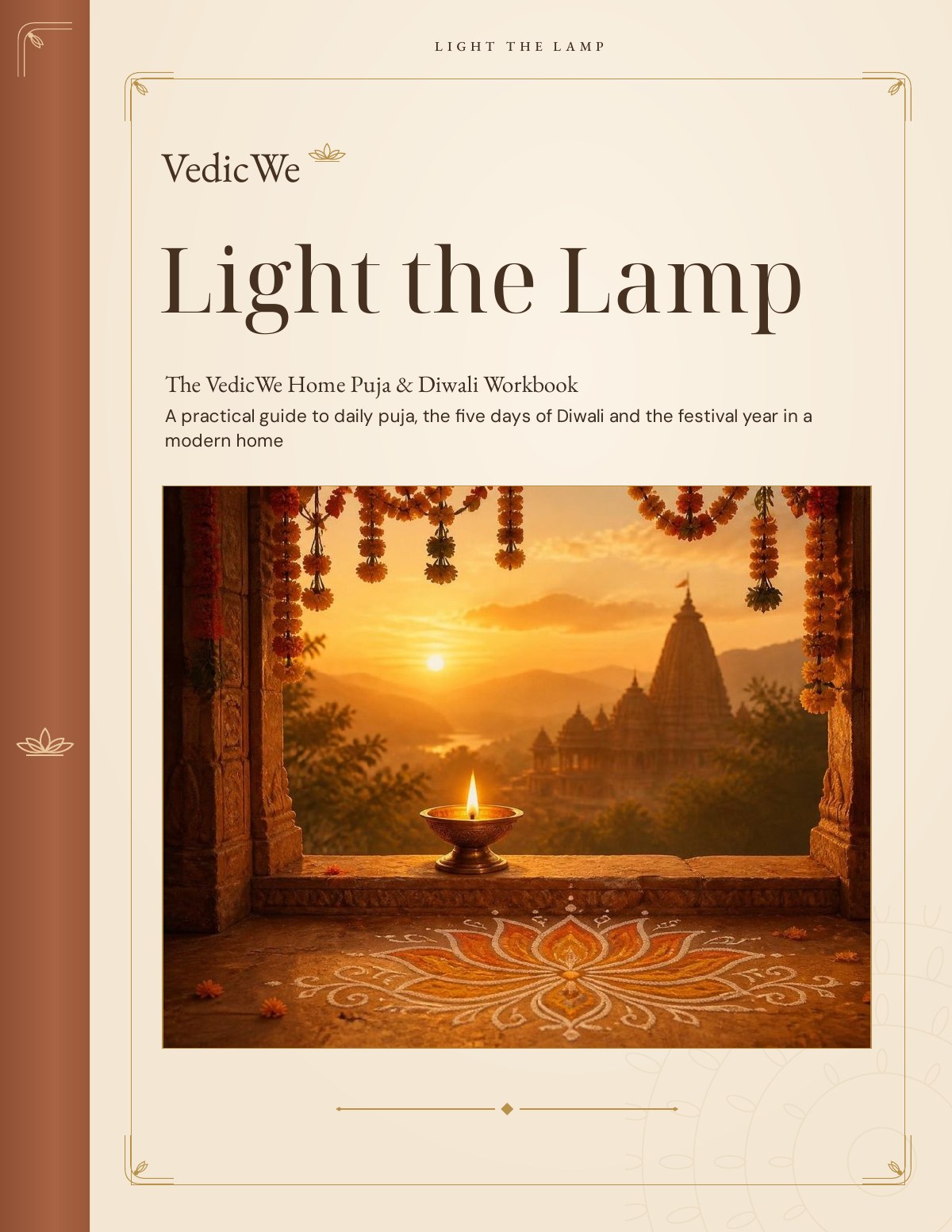
For home puja, Light the Lamp (Dhanteras to Bhai Dooj, day by day) is a 144-page PDF workbook ($5.99).
November 2026 festivals and observances
1 November — Ahoi Ashtami
Ahoi Ashtami falls on Krishna Ashtami in the Kartika calendar. Some families observe a fast and evening worship associated with children and family wellbeing. Fasting customs, the story and whether the fast ends at stars or moonrise vary. Keep any fast voluntary and suitable to the person observing. See our Ahoi Ashtami puja guide.
5 November — Govatsa Dwadashi and Rama Ekadashi
The New Delhi calendar places Govatsa Dwadashi and Rama Ekadashi on this date. Govatsa Dwadashi is a cow-and-calf observance in communities that follow it; Rama Ekadashi is an Ekadashi vrata associated with Vishnu devotion. Practices differ, and an Ekadashi fast is not appropriate for everyone. Follow local guidance rather than treating a single fasting rule as universal.
6 November — Dhanteras
Dhanteras, also called Dhan Trayodashi, falls on Kartika Krishna Trayodashi. Many households clean and light lamps, and some observe Lakshmi and Dhanvantari worship or buy an item according to family custom. Purchasing something is not a religious requirement. See the Dhanteras puja vidhi.
7 November — Kali Chaudas
Kali Chaudas is observed in parts of western India on the Chaturdashi before Diwali. The name and associated customs are regional; some communities include worship connected with Kali or Hanuman and household lamps. Do not assume one ritual applies across India.
8 November — Narak Chaturdashi, Lakshmi Puja and Diwali
The calendar places Narak Chaturdashi and Diwali/Lakshmi Puja on adjacent or overlapping tithi observances in some locations and traditions. Diwali marks a major festival of lamps and household worship; Lakshmi Puja is performed by many families, while details of deity order, offerings and timing vary. Check the local Lakshmi Puja muhurta for your city. Our Diwali puja guide, Lakshmi puja guide and Diwali puja items checklist cover home planning. Keep open flames attended and away from children, pets and combustible materials.
10–11 November — Govardhan Puja and Bhaiya Dooj
Govardhan Puja is listed on 10 November in the New Delhi reference calendar; some regional calendars place it on 9 November. Families may worship Krishna and Govardhan Hill and prepare an offering such as annakut where that custom is followed. Bhaiya Dooj is listed on 11 November and celebrates the sibling bond through family visits and a customary tilak or meal. The form of observance is not identical in every region.
15 November — Chhath Puja
Chhath Puja is a multi-day solar observance especially associated with Bihar, Jharkhand, eastern Uttar Pradesh and diaspora communities. Devotees may offer arghya to the setting and rising sun at a clean water body, with community-specific preparation and food practices. The observance can involve demanding fasting; health and safety take priority, and no one should be pressured to fast or enter unsafe water. See the Chhath Puja ritual guide.
16–18 November — Vrishchika Sankranti, Gopashtami, Akshaya Navami and Jagaddhatri Puja
Vrishchika Sankranti is the Sun’s transition into Vrishchika in the solar calendar. Gopashtami (17 November) is observed in some Vaishnava communities with devotion to Krishna and care for cows. Akshaya Navami and Jagaddhatri Puja are listed on 18 November in the reference calendar; Jagaddhatri worship is especially visible in parts of Bengal. These observances are regional and their puja details should be checked with a local temple or panchang.
20–21 November — Kansa Vadh and Devutthana Ekadashi; Tulasi Vivah
Kansa Vadh is associated in Krishna traditions with the account of Krishna defeating Kansa. Devutthana (Prabodhini) Ekadashi marks the awakening of Vishnu in traditions that observe the Chaturmas transition; some communities hold Tulasi Vivah on 21 November, a symbolic ceremonial marriage of Tulasi and Vishnu/Krishna. The date and ceremony may instead be observed on Dwadashi or another locally determined day. Follow the calendar used by your household or temple.
22–24 November — Pradosh, Vaikuntha Chaturdashi and Kartika Purnima
Pradosh Vrat (22 November) is a Shiva observance tied to Trayodashi evening in traditions that keep it. Vaikuntha Chaturdashi is observed by some communities with worship of Shiva and Vishnu. Kartika Purnima/Dev Diwali is listed on 24 November; devotees may mark the full moon with prayer, lamps, charity or a pilgrimage bath where customary. Karthigai Deepam also falls on this date in the solar calendar and is a distinct Tamil lamp festival. Local dates can differ.
27 November — Ganadhipa Sankashti Chaturthi
Sankashti Chaturthi is a monthly Ganesha vrata observed by some devotees with prayer and a fast, often concluded after moonrise. The moonrise time is city-specific. The New Delhi calendar names this occurrence Ganadhipa Sankashti; check the local panchang before using a timing from another city.
December 2026 festivals and observances
1 December — Kalabhairav Jayanti and Kalashtami
Kalabhairav Jayanti falls on Krishna Ashtami in the New Delhi reference calendar, alongside monthly Kalashtami observances. Devotees who observe the day may offer prayer to Bhairava; forms of worship, temple practice and fasting are tradition-specific. Do not use a generic online muhurta as a substitute for a local calendar.
4 December — Utpanna Ekadashi
Utpanna Ekadashi is the Krishna Paksha Ekadashi of Margashirsha in this calendar. It is observed by Vishnu devotees through prayer, recitation or fasting according to personal capacity and lineage. Ekadashi food rules differ between households; fasting is optional and should not compromise health.
6–10 December — Pradosh, Masik Shivaratri, Amavasya and Chandra Darshan
Ravi Pradosh is listed on 6 December and Masik Shivaratri on 7 December. Darsha/Margashirsha Amavasya is listed on 8 December, followed by Ishti on 9 December and Chandra Darshan on 10 December. These are recurring lunar observances; worship, tarpan, fasting and meal customs vary by family, region and tradition. The tithi boundary and any ritual timing must be checked for the location.
14–17 December — Vivah Panchami, Champa/Skanda Shashthi and Dhanu Sankranti
Vivah Panchami (14 December) commemorates the wedding of Rama and Sita in traditions that mark the day. Champa Shashthi and Skanda/Subrahmanya Shashthi are listed on 15 December and are associated with worship of Skanda/Kartikeya in different regional forms. Dhanu Sankranti (16 December) marks the Sun’s entry into Dhanu in the solar calendar. Observance varies; a festival name can refer to different regional customs.
17 December — Masik Durgashtami
Masik Durgashtami falls on Shukla Ashtami in the monthly lunar cycle. Some devotees worship Durga with prayer or offerings. It is a recurring monthly observance, not the same event as the major Navaratri Ashtami in every tradition.
20 December — Gita Jayanti, Mokshada Ekadashi and Vaikuntha Ekadashi
The New Delhi calendar lists Gita Jayanti and Mokshada Ekadashi together on Margashirsha Shukla Ekadashi. Some solar-calendar communities observe Vaikuntha Ekadashi on this date as well. Gita Jayanti is associated with the Bhagavad Gita; devotees may read or recite it. Ekadashi prayer and fasting practices vary, and the Vaikuntha observance is not dated identically by every calendar.
21 December — Soma Pradosh and monthly Karthigai
Soma Pradosh is a Monday Trayodashi observance in traditions that keep Pradosh Vrat. Monthly Karthigai is listed in the solar calendar. The calendar names describe distinct observances; consult the local tradition for the relevant puja sequence and timing.
23–26 December — Dattatreya Jayanti, Margashirsha Purnima and Akhuratha Sankashti
Dattatreya Jayanti and Margashirsha Purnima are listed on 23 December in New Delhi; some locations list Purnima on 24 December. Devotees may mark Dattatreya Jayanti with prayer to Dattatreya and observe Purnima through customary worship, charity or a fast. Akhuratha Sankashti Chaturthi is listed on 26 December in the New Delhi calendar (27 December in some other locations). Check local moonrise before planning a Sankashti fast.
January 2027 festivals and observances
3 January — Saphala Ekadashi
Saphala Ekadashi falls on Pausha Krishna Ekadashi in the New Delhi calendar. Vishnu devotees may observe it with prayer, scripture reading or a personal fasting practice. Food restrictions are not universal and should be followed only when suitable to the person observing.
14–16 January — Lohri, Bhogi, Makar Sankranti and Pongal
Drik Panchang’s Indian calendar lists Lohri on 14 January, with Makar Sankranti and Pongal on 15 January; the Indian Meteorological Department’s Rashtriya Panchanga lists Lohri on 13 January and Bhogi/Makar Sankranti regional observances on 14–15 January. This difference is a reminder to use the calendar relevant to your place and community. Lohri is a winter harvest celebration strongly associated with Punjab; Bhogi precedes Pongal in parts of South India. Makar Sankranti marks the Sun’s transition into Makara. Pongal is a Tamil harvest festival whose observance may include cooking the new-season rice dish and honoring the Sun, cattle and household abundance. Mattu Pongal follows on 16 January in the cited Indian calendar. These customs are regional, not one interchangeable ritual. Use local guidance for the date and any muhurta.
15 January — Guru Gobind Singh Jayanti
The Indian calendar lists Guru Gobind Singh Jayanti on 15 January 2027. Sikh observance belongs to Sikh religious life; families and gurdwaras may mark the occasion through prayer, kirtan and community service. Date observance can vary by calendar and location. VedicWe includes this entry as a nearby Indian religious-calendar observance, not as a Hindu puja instruction.
18–19 January — Pausha Putrada Ekadashi
Pausha Putrada Ekadashi is listed on 18 January, with a Gauna observance on 19 January in the New Delhi calendar. Vaishnava communities may use different Ekadashi calculations. The title is traditional; it is not a promise of fertility or a medical outcome. Fasting is optional and must be appropriate to the individual.
22 January — Pausha Purnima
Pausha Purnima is the full-moon observance in the Pausha month. Prayer, charity, pilgrimage and fasting may form part of some household or regional traditions. Bathing practices should follow local safety and community guidance.
25 January — Sakat Chauth
Sakat (Sankatahara) Chauth is a Krishna Chaturthi vrata associated with Ganesha and observed in some North Indian communities for family wellbeing. Some devotees keep a fast and offer prayer after moonrise; the name, story and food customs vary. Use the local moonrise time and do not pressure anyone to fast.
How to use this festival calendar
- Choose the city and regional calendar used by your family or temple.
- Confirm the tithi, sunrise or moonrise rule and any muhurta locally; dates above are not universal timings.
- Ask which steps, offerings and restrictions belong to your own tradition. Lists online are references, not requirements.
- Make fasting voluntary and safe. Do not delay medical care or treat ritual observance as a substitute for health advice.
- Plan lamps and cooking safely, and adapt observances for accessibility, weather and local conditions.
For ongoing practice, browse the Ritual library, our Diwali puja guide, Chhath Puja guide, and Dhanteras guide.
Frequently asked questions
What Hindu festivals are coming up in November 2026?
The New Delhi reference calendar includes Ahoi Ashtami, Govatsa Dwadashi, Rama Ekadashi, Dhanteras, Kali Chaudas, Narak Chaturdashi, Diwali/Lakshmi Puja, Govardhan Puja, Bhaiya Dooj, Chhath Puja, Devutthana Ekadashi, Tulasi Vivah and Kartika Purnima, among other monthly observances.
What are the major Hindu festivals in December 2026?
The calendar includes Kalabhairav Jayanti, Utpanna Ekadashi, Vivah Panchami, Champa/Skanda Shashthi, Dhanu Sankranti, Gita Jayanti/Mokshada Ekadashi, Dattatreya Jayanti and Margashirsha Purnima, alongside recurring vrats.
When are Lohri, Makar Sankranti and Pongal in 2027?
Published Indian calendars differ by location: Drik Panchang lists Lohri on 14 January and Makar Sankranti/Pongal on 15 January for its 2027 Indian calendar, while the IMD Rashtriya Panchanga shows regional observances on 13–15 January. Follow the calendar for your city and community.
Do these festival dates apply in the United States, Canada, the UK or Singapore?
Not necessarily. Tithi and sunrise calculations can change the local date, and diaspora temples may follow a specific regional or sampradaya calendar. Select your location in a trusted panchang and confirm with your temple.
Does this list include every festival in India?
No single page can represent every regional, sectarian and community calendar. This guide covers named Hindu festivals and recurring ritual observances in the cited New Delhi reference calendars during the stated date range, plus selected Indian regional observances. It is not exhaustive across religions or communities.
Sources
- Drik Panchang: 2026 Hindu calendar for New Delhi
- Drik Panchang: November 2026 festival calendar
- Drik Panchang: December 2026 festival calendar
- Drik Panchang: 2027 Hindu calendar for New Delhi
- Drik Panchang: 2027 Indian calendar
- India Meteorological Department: Rashtriya Panchanga festivals
Calendar references were checked on 27 October 2026. This is cultural information, not a universal ritual prescription. Follow local panchang, family tradition and qualified community guidance.