
Direct answer
There is no single Diwali puja items list used by every Hindu household. A published Lakshmi Puja samagri list may include a clean altar, images or murtis used by that family, a lamp, flowers, water, offerings such as fruit or sweets, and tradition-specific items. Treat lists as examples: ask which parts belong to your household practice, use modest quantities, and do not buy objects to prove devotion.
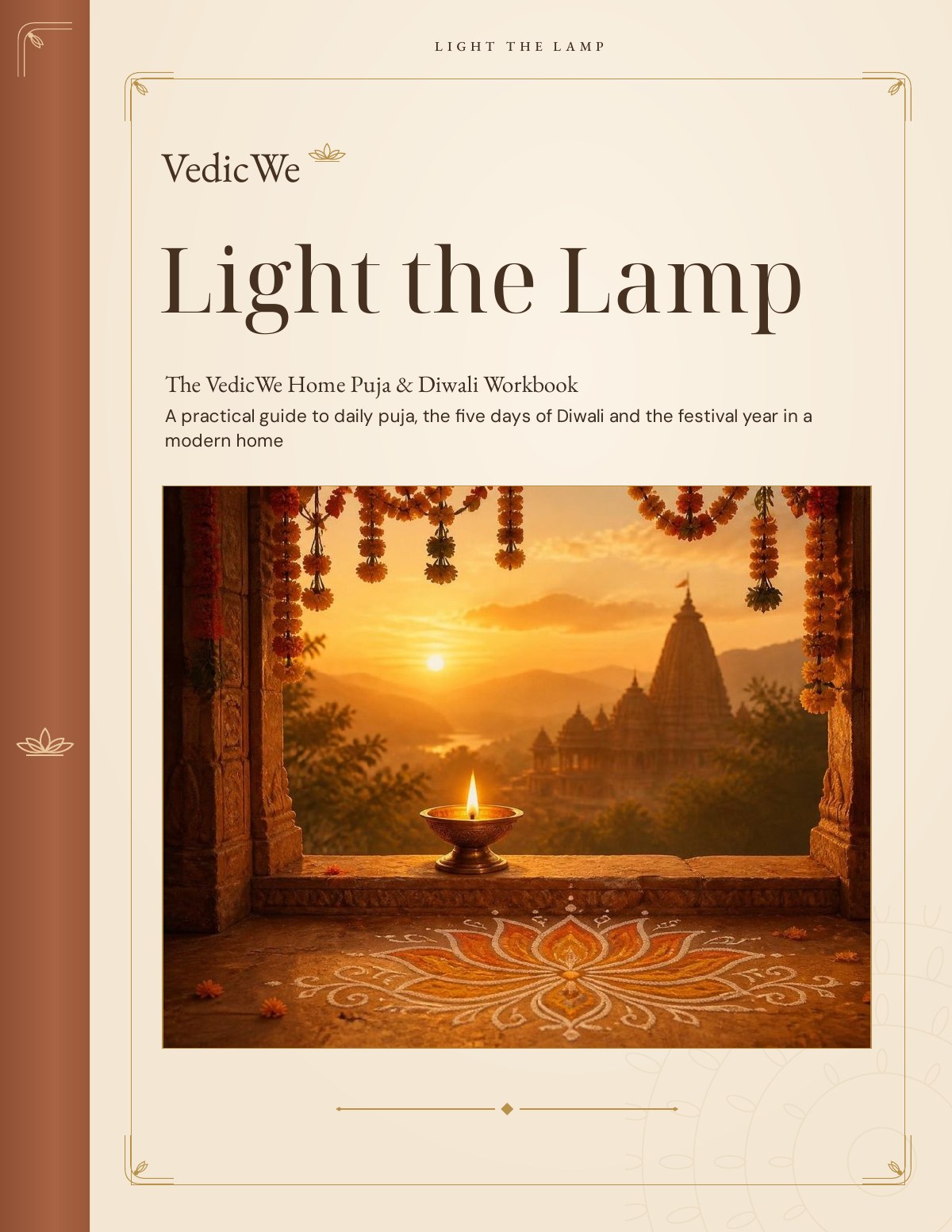
For home puja, Light the Lamp (Dhanteras to Bhai Dooj, day by day) is a 144-page PDF workbook ($5.99).
A practical Diwali puja checklist
Use these groups to plan ahead. Every item is optional unless your own family or community tradition calls for it.
Set up the space
- A stable, clean surface for the puja area.
- The image, murti or other focus already used by your household. Some Lakshmi Puja traditions include Ganesha; others organise the observance differently.
- A clean cloth or small seat if it is part of your practice.
- A small vessel of water and a plate or bowl for offerings.
Choose offerings used in your tradition
- Fresh flowers or leaves your household normally offers.
- Fruit, sweets or another modest naivedya that is suitable for the people who will share it.
- Rice or akshata, kumkum, sandalwood paste, incense or other familiar puja materials only when they belong to your practice.
- Prayer text, account book or pen if your family includes them in its Diwali observance.
Plan lamps and clean-up
- A stable diya or lamp, the fuel and wick used by your household, and a heat-resistant base.
- A way to extinguish the flame safely and a clear area away from curtains, paper, clothing and crowded walkways.
- A tray or container for used flowers, food and other offerings; follow family custom and local waste guidance when clearing the altar.
Why published samagri lists differ
Drik Panchang publishes one detailed Lakshmi Puja samagri list for Deepavali. It includes household and regional items beyond a simple altar, and explicitly describes itself as a special Diwali list rather than a list of daily puja materials. The Government of India’s Incredible India Diwali overview describes a multi-day festival celebrated across communities, with different days and practices. Together these sources are useful references, not proof of one required list for every region or family.
Before shopping, compare any online Diwali pooja items list with your own observance. A list may combine materials for several days, a particular regional sequence, or a specific form of Lakshmi Puja. It may also name items that are unavailable, unnecessary for your household, or not appropriate for children, pets, allergies or your living space. A simpler observance is still an observance.
Prepare without overspending
Review what you already have before buying anything. Reuse clean vessels, lamps and cloth where appropriate. Choose offerings that can be shared and avoid perishable quantities you cannot use. No purchase, metal, decoration or branded kit guarantees wealth or a particular outcome. Be cautious of sales language that turns ritual practice into fear or financial pressure.
If a priest or family elder has given your household a sequence, ask which materials are essential to that specific rite and which are optional. The answer may differ by region, language, sampradaya and the form of worship. Our Diwali puja vidhi guide explains those regional differences; the Lakshmi Puja at home guide covers preparation and sequence.
Keep lamps and incense safe
Place lamps on a stable, heat-resistant surface and keep burning candles or diyas attended. Clear nearby combustible materials, keep children and pets at a safe distance, and extinguish flames before sleeping or leaving. Ventilate smoke and skip incense if it irritates anyone. A battery lamp or a smoke-free alternative can support participation when open flame is not practical.
Frequently asked questions
What items are needed for Diwali puja at home?
The items depend on the household tradition. Common planning groups include a clean altar, the family’s usual image or murti, water, a lamp, familiar flowers or leaves, and a modest offering. Ask which additional samagri applies to your own practice.
Is there one complete Diwali pooja samagri list?
No single list is universal. Published lists describe particular traditions and may cover multiple festival days. Use one as a reference, then adapt it with family or community guidance.
Can I do Diwali puja without buying new items?
Yes. Use the clean, reusable materials already part of your household practice. The number or cost of items is not a measure of devotion, and no purchase guarantees a material outcome.
How can I use diyas safely?
Set each lamp on a stable heat-resistant base, keep it attended and away from combustible materials, children and pets, and extinguish it before leaving or sleeping. Follow local fire-safety guidance.
Sources
- Drik Panchang: Lakshmi Puja items during Deepavali
- Incredible India: Diwali
- National Fire Protection Association: candle safety
This is a cultural planning guide, not a priestly prescription. Follow the practice and safety needs of your household and community.